SMART AUDIT

5 Best Audit Management Software & Tools (Complete Buyer’s Guide)

16 Dec 2025

As regulatory requirements tighten and audits become more frequent, businesses are rapidly moving away from spreadsheets, paper checklists, and disconnected tools.

In 2026, audit management software is no longer a “nice-to-have.”
It has become a core compliance and risk management system for organizations across food manufacturing, pharmaceuticals, healthcare, retail, logistics, and enterprise operations.

This guide explains:

  • what audit management software really is
  • How Audit Management Software Works (Step-by-Step).
  • what problems it solves
  • how to choose the right tool
    and the 5 best audit management software tools in 2026, based on real buying criteria,

What Is Audit Management Software?

Audit management software is a digital system that centralizes the planning, execution, documentation, analysis, and reporting of audits across an organization. It replaces manual spreadsheets, paper checklists, and email-based follow-ups by providing a structured, traceable, and auditable workflow for compliance and quality audits.

What Audit Management Software Is NOT

To avoid confusion here is the clear explanation

  • It is not just a checklist app
  • It is not only a document storage tool
  • It is not limited to internal audits
  • It is not the same as a full QMS (though it often integrates with one)

Why Businesses Need Audit Management Software in 2026

In 2026, increasing regulatory scrutiny and audit frequency make manual audit processes unreliable and risky. Paper checklists, spreadsheets, and email-based tracking lack the consistency, traceability, and speed required for modern compliance.

Common Problems With Manual Audits

  • Inconsistent audits across locations
  • Missed nonconformities
  • Delayed or forgotten corrective actions
  • Weak audit trails and poor traceability
  • Incomplete or unreliable regulatory evidence
  • Reactive, last-minute audit preparation

As compliance expectations rise, these gaps increase the risk of audit failures, penalties, and operational disruption. Audit management software enables standardized audits, real-time visibility, and proactive compliance control, making it essential for businesses.

How Audit Management Software Works (Step-by-Step)

A modern audit management system typically follows this workflow:

  1. Audit Planning & Scheduling
    Assign audits by location, process, or regulation.
  2. Digital Checklist Execution
    Auditors conduct audits using standardized digital templates.
  3. Evidence Capture
    Photos, videos, timestamps, GPS logs, and notes are recorded.
  4. Nonconformity Identification
    Issues are automatically flagged based on responses.
  5. Corrective Action (CAPA) Assignment
    Tasks are assigned with deadlines and owners.
  6. Verification & Closure
    Actions are verified and closed with proof.
  7. Reporting & Analytics
    Dashboards highlight trends, risks, and performance gaps.
    This closed-loop process is what separates audit management software from simple inspection tools.

How Audit Management Software Supports Compliance Standards

Audit management software plays a critical role in helping organizations meet regulatory and certification requirements by creating structured, traceable, and verifiable audit processes.

For FSMA (Food Safety Modernization Act), audit software helps verify preventive controls, maintain digital monitoring records, track corrective actions end to end, and generate audit-ready documentation during inspections.

In HACCP-based programs, audit management systems support CCP monitoring, trigger alerts when deviations occur, maintain verification records, and ensure audits are backed by clear, time-stamped evidence.

For GFSI-recognized standards such as BRCGS, SQF, and FSSC 22000, audit software standardizes internal audit programs, simplifies supplier audits, and enables continuous improvement tracking across sites.

By directly aligning regulatory requirements with digital audit workflows, audit management software strengthens compliance reliability, improves audit outcomes, and supports confident decision-making for both auditors and management

How We Evaluated the Best Audit Management Software Tools

To ensure this guide is accurate, unbiased, and useful for decision-makers, each audit management software tool was evaluated using the same set of practical criteria.

We focused on factors that directly impact day-to-day usability.

  • compliance performance, and long-term value,
  • including ease of use for auditors and operators.
  • coverage of the full audit lifecycle.
  • compliance readiness for regulatory and certification audits.
  • strength of corrective action and reporting workflows.
  • scalability across multiple sites. implementation effort,
    and overall cost versus value over time.

This consistent evaluation approach helps buyers compare tools objectively and choose software that fits both current needs and future growth.

5 Best Audit Management Software & Tools in 2026

After evaluating usability, compliance depth, scalability, and long-term value, the following tools stand out as the best audit management software options for different business needs.


1. Smart Audit – Best All in One Audit Management Software

Best for: Small to mid sized businesses, regulated industries, and multi-location operations.

Smart Audit ranks as the best overall audit management software in 2026 because it delivers enterprise-level audit capabilities while remaining easy to use, affordable, and quick to implement and getting started with your business needs.

Why Smart Audit Stands Out

Unlike basic inspection tools, Smart Audit is designed to support the entire audit lifecycle, from planning and execution to corrective action tracking and reporting, within a single, unified system.

Key Features

  • Digital audit checklists for internal, supplier, and compliance audits
  • Offline audit execution for field teams
  • Evidence capture including photos, videos, timestamps, and notes
  • Automated identification of nonconformities
  • Built-in CAPA workflows with accountability tracking
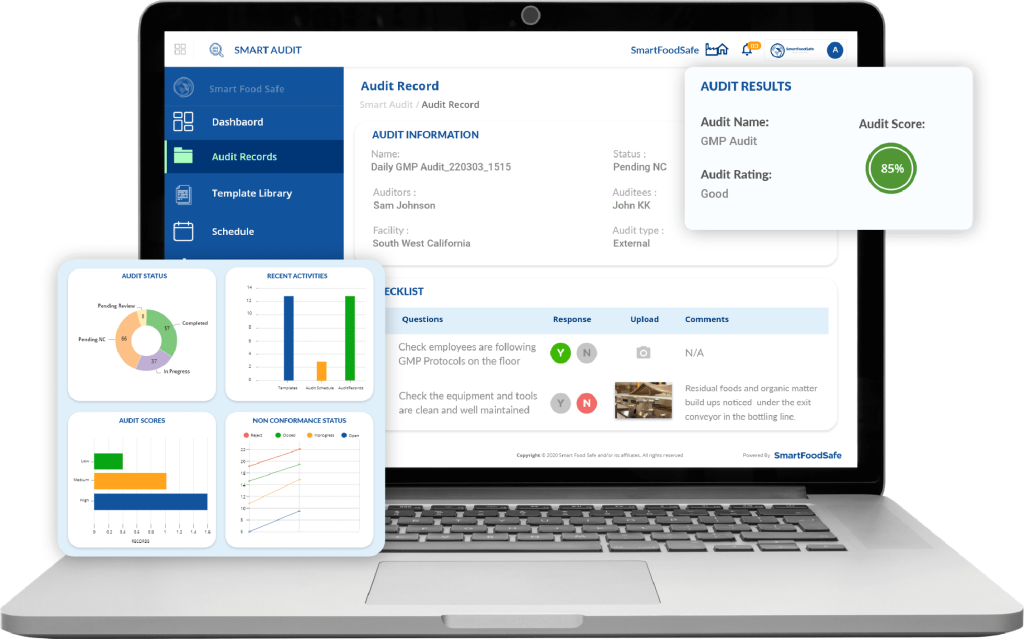
  • Real-time dashboards and audit analytics
  • Centralized visibility across multiple sites
  • Role-based access control for teams
  • Audit-ready reports for regulatory and certification audits 

Ease of Use

Smart Audit is designed for frontline adoption, requiring minimal training. Auditors can create checklists quickly, complete audits efficiently, and submit reports without technical complexity, driving high adoption across teams.

Compliance Strength

Smart Audit supports a wide range of compliance programs, including:

  • FSMA audits
  • HACCP verification and CCP monitoring
  • GFSI internal audits
  • Supplier and third-party audits
  • Operational and quality audits

Why It’s #1 in 2026

Smart Audit consistently balances usability, compliance depth, affordability, and scalability, making it ideal for organizations that want strong compliance control without unnecessary complexity.


2. iAuditor (SafetyCulture) – Best for Inspections, Limited for Full Audit Programs

Best for:  Safety inspections and routine operational checks.

iAuditor is a popular and easy-to-deploy platform commonly used for inspections. While it performs well for checklist-based audits, it functions more as an inspection tool than a full audit management system.

Large Pre-Built Checklist Library: Templates for safety, facility, operational checks

Mobile Inspection App: Easy-to-use smartphone interface for field teams

Photo & Annotation Support: Capture evidence and annotate directly

Conditional Logic: Show questions based on prior responses

Offline Mode: Conduct inspections offline with auto-sync


3. Audit Board – Best for Enterprise Internal Audit Teams

Best for : Large enterprises with dedicated internal audit and risk management teams.

AuditBoard is a powerful platform focused on internal audit, risk, and compliance management, but it is designed primarily for enterprise environments.

Risk & Control Management: Advanced frameworks for enterprise risk

SOX Audit Support: Built-in support for Sarbanes-Oxley controls

Workflow Automation: Route findings through approval and review

Centralized Audit Repository: Access all audit records in one place

Dashboards & Analytics: Detailed risk insights and trends

Advanced Reporting: Customizable enterprise reports


4. GoAudits – Best for Retail & Franchise Audits

Best for : Retail chains, QSR brands, hospitality groups, and franchise operations.

GoAudits focuses on operational consistency across locations, making it popular in retail and hospitality environments.

Mobile-First Audit Execution: Designed for use in stores and field locations

Store-Level Performance Tracking: Scorecards and operational dashboards

Template Builder: Create custom operational checklists fast

Real-Time Reporting: View audit results immediately

Photo Evidence Capture: Attach evidence to audit items

Exportable Reports: Generate PDF or CSV reports


5. SafetyChain – Best for Enterprise Food Safety Programs

Best for : Large food manufacturers with established food safety and compliance teams.

SafetyChain is a specialized platform with strong food safety capabilities, designed for complex and highly regulated environments.

Comprehensive FSMA & HACCP Modules: Deep compliance support

Supplier Management: Track supplier performance and compliance

Temperature & Environmental Data Logging: Integrates sensor and process data

Corrective Action Workflows: Assign and track CAPA processes

Advanced Reporting & Dashboards: Food safety centric compliance insights
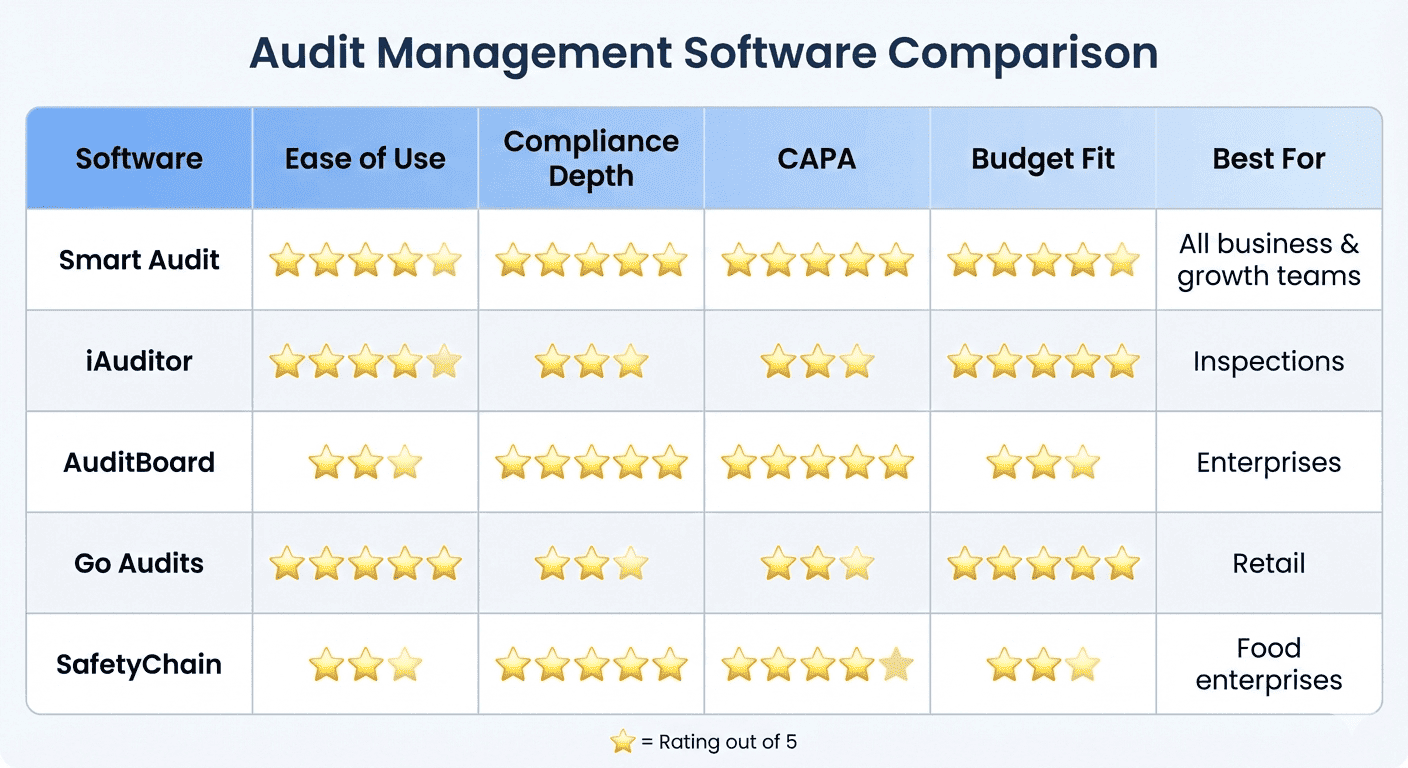
Comparison Table: Best Audit Management Software in 2026

Common Mistakes When Choosing Audit Management Software

  • Buying based on features instead of usability
  • Ignoring CAPA workflows
  • Underestimating implementation effort
  • Choosing enterprise tools for SMB needs
  • Not planning for multi-site scaling

Common Mistakes When Choosing Audit Management Software

Many organizations select audit management software based on surface-level features rather than real operational needs. The most common mistakes include choosing tools with extensive features but poor usability, which leads to low adoption by audit teams. Ignoring corrective and preventive action (CAPA) workflows is another critical error, as unresolved findings weaken compliance programs over time.

Businesses also often underestimate the effort required to implement and maintain audit software, especially when workflows are complex. Selecting enterprise-grade platforms for small or mid-sized operations can introduce unnecessary cost and complexity. Finally, failing to plan for multi-site scaling can limit long term value as operations grow.
How to Choose the Best Audit Management Software for Your Business

To select the right audit management software, decision-makers should evaluate the tool against practical, long-term requirements rather than short-term convenience.

Ask the following questions before making a decision:

  • Who will conduct audits on a daily basis, and how technical are those users?
    In most organizations, audits are conducted by frontline supervisors, quality managers, safety officers, or operations staff rather than IT specialists. Audit management software should therefore be intuitive, mobile-friendly, and easy to use with minimal training. High usability ensures consistent audit execution and higher adoption across teams.
  • Which regulations, standards, or certifications must the business comply with?
    The required software should align with the specific compliance frameworks relevant to the business, such as FSMA, HACCP, ISO standards, or GFSI schemes like BRCGS, SQF, or FSSC 22000. Choosing software that directly supports these standards simplifies audits and reduces regulatory risk.
  • How many locations, departments, or suppliers need to be audited?
    Businesses with multiple locations, departments, or suppliers need centralized visibility and standardized audit processes. Audit management software should support multi-site audits, real-time reporting, and cross-location comparisons to maintain consistency and control.
  • Is strong corrective action tracking essential for closing compliance gaps?
    Yes. Effective corrective and preventive action (CAPA) tracking is critical for resolving nonconformities, preventing repeat issues, and demonstrating continuous improvement during audits. Without strong CAPA workflows, audit findings often remain unresolved.
  • How will audit requirements evolve over the next two to three years?
    Audit requirements typically expand as businesses grow, regulations tighten, or operations become more complex. Selecting scalable audit management software ensures the system can support additional locations, users, audit types, and compliance standards without needing to change platforms.

Answering these questions helps ensure the chosen audit management system supports both current compliance needs and future business growth.

Frequently Asked Questions (FAQ)

The best audit management software in 2026 is one that combines ease of use, strong compliance support, and scalability. SmartAudit is considered one of the leading options because it balances usability with robust audit lifecycle management and regulatory readiness.

Yes. Audit management software helps small businesses reduce compliance risk, standardize audits, and maintain accurate documentation without relying on spreadsheets or paper-based processes.

Most modern audit management software platforms can be implemented within a few days to a few weeks, depending on the number of audit templates, locations, and users involved.

Yes. Audit management software centralizes audit execution, evidence collection, corrective actions, and reporting in a single system, eliminating the need for spreadsheets and manual documentation.

Yes. When configured correctly, audit management software supports regulatory and certification audits such as FSMA, HACCP, ISO, and GFSI by providing standardized workflows, traceable records, and audit-ready documentation.

Audit Management Software

Have a consistent, working internal audit strategy that continuously brings about compliance in the middle of regulatory updates with Smart Audit’s audit management features.

Audit Management Software

Have a consistent, working internal audit strategy that continuously brings about compliance in the middle of regulatory updates with Smart Audit’s audit management features.