English
 French
 Spanish


For decades, compliance audits have largely relied on basic tools—Excel spreadsheets, Word templates, and manual checklists. These tools, while once revolutionary, were never designed to support the complexity, scale, and regulatory precision that today’s businesses demand.
As audit requirements grow more stringent and cross-functional, traditional methods show their limitations. Manual data entry, scattered documentation, and disjointed workflows often result in inefficiencies, inconsistencies, and missed non-conformances. Worse yet, they leave compliance teams in a reactive mode—scrambling to pull records together when audits or inspections loom.
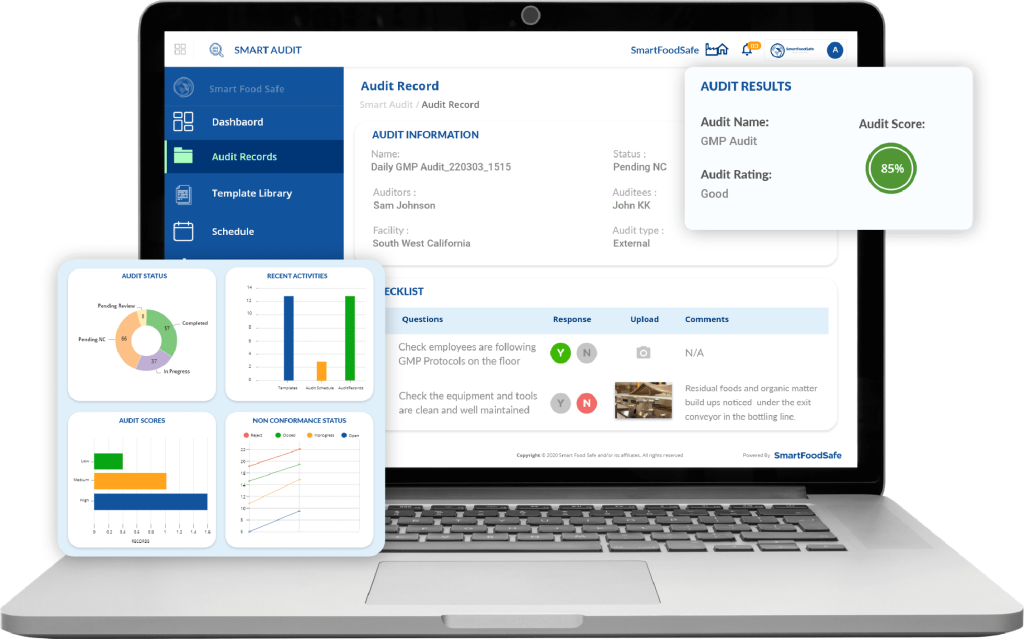
Going digital with your audit management efforts will help remediate the shortcomings associated with the conventional methods of audit execution. Smart Audit is one such tech-enabled offering that makes this possible with targeted features to facilitate the audit lifecycle, driving successful audit outcomes.
Why Traditional Audit Methods Are No Longer Enough: The Cracks in the Foundation
The reliance on spreadsheets, documents, and email trails may have once sufficed—but in today's fast-paced, regulation-heavy environment, these outdated methods can no longer keep up.
1. Fragmented Workflows and Siloed Systems
In conventional audit processes, teams often juggle between Excel spreadsheets for scoring, Word documents for audit reports, and email threads for follow-ups. These disconnected tools create a fragmented workflow, making it difficult to maintain a unified audit trail. Each update or correction requires manual syncing across multiple files, leading to duplication, version control issues, and the ever-present risk of human error.
2. Manual Documentation is Prone to Oversight
Auditors relying on pen-and-paper checklists or editable templates must spend considerable time on data entry, formatting, and compiling evidence. These manual touchpoints not only delay reporting but also heighten the risk of missed non-conformances or incomplete corrective action records. Over time, these blind spots can snowball into critical compliance gaps—especially in highly regulated industries like food and beverage, pharmaceuticals, or manufacturing.
3. Lack of Real-Time Visibility and Traceability
With legacy methods, compliance managers struggle to get a real-time snapshot of audit statuses, pending actions, or recurrence patterns. Without centralized access to audit histories and performance trends, identifying systemic risks or recurring issues becomes a retrospective, labor-intensive task. This lack of traceability leaves organizations vulnerable to compliance failures and unprepared for unannounced audits or regulatory inspections.
4. Reactive Rather Than Proactive Compliance Culture
When audits are driven by deadlines rather than insights, teams are often in a “firefighting” mode—rushing to compile documentation or fix last-minute discrepancies. This reactive approach undermines the very purpose of audits: to continuously improve quality, safety, and operational excellence. Traditional systems fall short in supporting preventive actions or driving accountability across departments.
Why a Change in the Compliance Audit Management Scenario is Long Overdue
The regulatory landscape is becoming more complex with rising standards such as ISO 9001, FDA 21 CFR Part 11, GFSI schemes, and ESG mandates. Regulatory bodies now expect traceable, data-driven decision-making in compliance audit reports—not just paper checklists and spreadsheets.
And also, remote and hybrid operations are here to stay. Traditional audit tools are ill-equipped to handle multi-location audits, virtual site assessments, or secure data-sharing among geographically dispersed teams. Businesses need systems that are not only compliant but also agile, scalable, and purpose-built for the current regulatory demands.
This is where digital audit management platforms come into the picture. They provide a unified, cloud-based environment where audits can be planned, executed, reviewed, and analyzed—all in one place. Here’s how this shift makes a measurable difference:
- Centralized and Secure Audit Data – Access audit data, evidence, and historical records from a single source of truth.
- On-the-Go Audit Management – Conduct, document, and manage audits in real time from any location using mobile-enabled tools.
- Workflow Automation – Trigger corrective and preventive actions (CAPA), assign tasks, and send automated reminders for follow-up.
- Customizable Checklists – Tailor audits to your specific standards, SOPs, and regulatory requirements without repetitive manual edits.
- Real-Time Dashboards and Reports – Gain instant visibility into non-conformances, completion rates, and risk areas.
- Audit Trail Integrity – Ensure traceability with automatic version control, timestamped entries, and user-specific access rights.
Going digital doesn’t just streamline audits—it transforms them from isolated compliance checks into powerful tools to bridge gaps for continuous improvement and risk mitigation. And that’s exactly what Smart Audit brings to the table—a dedicated audit management solution designed for modern compliance expectations.
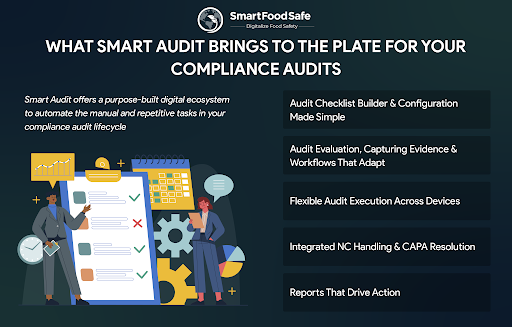
What Smart Audit Brings to the Plate for Your Compliance Audits
Smart Audit offers a purpose-built digital ecosystem that streamlines the entire audit lifecycle—planning, execution, reporting, and follow-up—by automating repetitive and manual tasks in your compliance audits, hence minimizing human error, reducing administrative overhead, and accelerating audit completion timelines.
Template Builder & Audit Configuration
⇒ Design Reusable Templates: Create fully customizable audit templates or build a template using AI-suggested fields or clone from the pre-configured templates in the library, aligned with industry standards.
⇒ Flexible Question Types: Create audit questions using multiple-choice, date pickers, free-text, sliders, number inputs, and conditional logic for dynamic flows.
⇒ Bring Your Audit Checklist: Save time by importing audit questions in bulk via Excel.
⇒ Scoring System: Assign scores and automate total scoring with visual rating scales. Define advanced scoring with support for color-coded ratings, and penalized and percentage-based methods, including logical conditions (AND/OR) for grouped assessments.
⇒ Response Validations: Enforce evidence uploads or comments based on question types so that users can embed supporting evidence (e.g., photos, files) directly into audit records.
⇒ Version Control: Track all changes with version-controlled templates for audit traceability.
⇒ Custom Workflows: Configure workflows for review assignments, NC routing, approvals, and link them to specific templates.
⇒ Notifications & Escalation: Stay ahead of compliance lapses with real-time notifications as well as automated escalations for pending tasks, missed deadlines, or overdue audits. Notification tone and frequency can be tailored to suit organizational needs.
Audit Execution & Record Management
⇒ Flexible Scheduling: Conduct audits on a recurring basis (daily, weekly, monthly, etc.) or as ad-hoc events.
⇒ Supports All Audit Types: Perform internal audits (involving employees within the organization), external audits (involving parties outside the organization to conduct the audits), or customer audits with ease.
⇒ Offline Support: Perform audits without internet access and auto-sync data when reconnected. Download audit forms, fill them offline in Excel, and re-upload with full UI sync.
Non-Conformance (NC) Handling & CAPA Integration
⇒ Auto NC Detection: Instantly flag non-conformances and move them to a dedicated NC stage.
⇒ NC Assignment: Assign issues to responsible users for corrective actions, preventive actions, and root cause analysis.
⇒ Workflow-Based Routing: Route NCs based on severity levels for review, escalation, or closure.
⇒ Future-Ready CAPA: Prepare for advanced NC resolution via different root cause analysis methodologies like Fishbone Diagrams, 5 Whys, and structured RCA workflows.
Mobile App Functionality
⇒ Mobile Access: Mirror web functionality in mobile for seamless audits anytime, anywhere. Perform audits on iOS and Android devices—online or offline—with automatic data sync.
⇒ Auto-Save on Mobile: Records are automatically saved in real-time on the mobile app, even if the user doesn’t tap “Save” or “Submit.” This prevents data loss in case of accidental navigation or unexpected screen exits.
⇒ Optimized Interface: With full-feature access on both desktop and mobile, audits can be conducted, reviewed, and submitted on any device.
Reporting & Insights
⇒ Custom & Global Reports: Generate audit and NC reports filtered by template, user, department, or timeframe.
⇒ Real-Time Dashboard: Visualize KPIs like audit counts, pending submissions, NCs raised, and performance trends in one centralized view.