English
 French
 Spanish


Audit tools are often built in English, but used by teams that aren't native English speakers. This creates a consistent and often overlooked problem: inspection records become less precise, corrective actions are only partially understood, and repeat findings continue to appear across audit cycles. On paper, everything looks complete, but in practice, there is a gap between what was observed and what was actually fixed. This pattern appears across audit teams in manufacturing, logistics, and construction, where the issue isn't process design or software configuration, but language itself. Multi-language support in audit management tools addresses this gap directly, not as a feature, but as a core requirement for reliable compliance.
1. Your Audit Records Reflect What Actually Happened
When someone completes a checklist in a language they are not fully comfortable with, the record they produce is a translation of what they observed, not a direct account of it. Terms like root cause, critical deviation, or verification frequency do not always carry over cleanly. The result is records that look complete but lose precision at every step.
Research suggests that a significant share of workplace incidents are linked to language-based miscommunication. In an audit context, this often appears as findings that do not match site conditions or non-conformance descriptions too generic to support meaningful corrective action.
When your audit tool presents every screen, question, and input field in the user's working language, you get records that reflect what the person actually found. That is the starting point for everything else in the audit programme to work properly.
2. Corrective Actions Actually Get Resolved
Slow CAPA closure is one of the most common problems audit teams face. Managers assume it is a prioritisation issue or a resourcing issue. Sometimes it is. But a significant portion of the time, the corrective action was not fully understood by the person responsible for carrying it out.
If someone receives a CAPA instruction in a language they partially understand, they tend to address what they could parse from it. Often that is the surface symptom. The underlying cause goes untouched. The non-conformance recurs. The audit manager notes it as a repeat finding. Nobody connects it to a comprehension gap that the audit platform created.
Delivering CAPA instructions, deadlines, and verification steps in the assignee's native language removes that gap. People understand what they are being asked to do, complete it properly, and confirm closure accurately. Repeat findings in the same category drop. Under regulatory frameworks, reducing repeat findings is one of the clearest signals that your audit management system is functioning as intended.
3. Audit Readiness Is Not Just a Management-Level Capability
Most organisations prepare well at the management level for external audits. The documentation is organised, the compliance officer knows the standards, the audit trail is clean. Then the certification auditor walks the floor and asks a production supervisor or site technician to walk through a recent corrective action. That conversation often goes poorly, not because the person did not do the work, but because the system they use to record and manage compliance was never designed with their language in mind.
SQF Edition 10 and ISO 45001:2018 both require demonstrated compliance culture at the operational level, not just at management. Auditors are trained to assess whether frontline workers can engage meaningfully with the safety and quality systems around them. A multilingual audit tool is a direct enabler of that. Workers who can read, complete, and act on compliance records in their own language participate in the programme rather than just passing through it.
That distinction matters during a culture assessment. An auditor interviewing a shift worker who can describe a recent inspection finding and explain what they did about it is seeing genuine compliance culture. That is a very different outcome from the same worker shrugging because the system has never felt like it was for them.
4. Multi-Site Compliance Data Becomes Comparable
Organisations running audit programmes across multiple sites in different regions face a consistent data quality problem: the records coming in from sites with multilingual workforces are less precise, less consistent, and harder to benchmark against sites where the platform language matches the workforce language.
When you try to identify systemic risk trends across a portfolio of sites, language-degraded data obscures the picture. A site might look like it has fewer non-conformances simply because its team records findings less specifically. A problem that cuts across three sites in different countries stays hidden because none of the records describe it the same way.
Multi-language audit platforms solve this by keeping the template identical and the language local. Every site uses the same questions, the same response logic, the same scoring. Every team answers in their own language. The data that feeds into your central compliance dashboard is genuinely comparable because it was not filtered through a translation layer that varies by person and site.
5. It Builds the Kind of Compliance Culture Auditors Look For
Compliance culture has become a formal audit criterion, not a soft concept. Leading global safety and quality frameworks now require auditors to assess whether compliance principles are genuinely embedded in day-to-day operations. That assessment does not happen only in documents. It happens in conversations with workers on the floor.
When workers use compliance tools in their native language, they engage with them differently. They report issues more readily. They take corrective actions more seriously. They ask questions instead of guessing. The system feels like it belongs to them rather than being something imposed from above that they have to navigate around.
Babbel for Business research found that language-related safety incidents at a 250-person facility can cost over $400,000 a year in direct costs. Turnover driven partly by language exclusion adds on top of that. A workforce that can engage with your audit system properly stays longer and performs better. Those are not abstract benefits. They show up in audit outcomes, insurance assessments, and certification renewals.
What Ignoring This Problem Actually Costs
Language gaps in audit management do not stay contained. They compound across every audit cycle, every CAPA review, and every certification renewal.
- Inaccurate audit records produce decisions and trend analyses built on unreliable data.
- Slow or incomplete CAPA closure creates recurring findings that flag systemic breakdown under ISO and GFSI frameworks.
- Inconsistent multi-site data hides systemic risks that only become visible when records are genuinely comparable.
- Higher workforce turnover driven partly by language exclusion continuously increases the proportion of your team operating below full compliance competency.
How SmartAudits Helps
An Enterprise Audit and Compliance Platform for Every Industry and Every Language
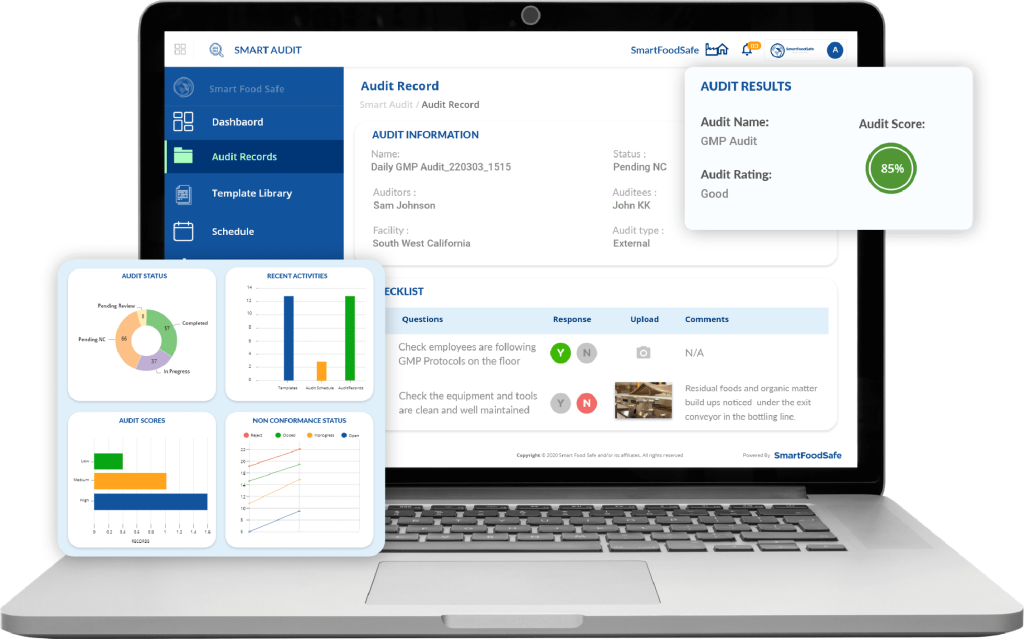
Smart Audits is an enterprise audit and compliance management platform built for EHS managers, operations and compliance leaders, and internal auditors across manufacturing, construction, logistics, utilities, and facilities management. Multi-language support is a core part of the platform, not an optional add-on.
Audit checklists, inspection forms, non-conformance records, CAPA assignments, and verification prompts can all be deployed in multiple languages at the same time. Each team member works in their own language. All responses feed into a centralised reporting layer that is fully benchmarkable across sites and accessible to group-level compliance teams in the language of their choice.
The warehouse operative raising a non-conformance in Portuguese, the site supervisor completing a daily inspection in Spanish, and the group compliance director reviewing cross-site trends in English are all working within the same audit programme. The data is consistent. The records are reliable. The compliance picture at the top reflects what is actually happening at the bottom.
Platform capabilities
Audit Management, Inspection Management, Non-Conformance Tracking, Corrective Actions (CAPA), Document Control, Supplier Audits, Incident Reporting, Training and Competency, Scheduling, KPI Dashboards and Regulatory Reporting.
Organisations that address the language gap in their audit management setup do not just pass audits consistently. They get compliance data they can actually trust, CAPA programmes that genuinely work, and a workforce engaged enough in the system to demonstrate the compliance culture their certification frameworks require.
Frequently Asked Questions
Multi-language support in audit management software allows users to interact with audit checklists, forms, and workflows in their preferred language. It ensures that frontline workers, auditors, and managers can understand and respond accurately without relying on manual translation.
Language directly affects how accurately audit findings, non-conformances, and corrective actions are recorded and understood. Misinterpretation due to language barriers can lead to incomplete actions, repeat findings, and unreliable compliance data.
Yes. Multilingual audit tools improve accuracy by allowing users to record observations in their native language, reducing ambiguity and ensuring that findings reflect actual site conditions more precisely.
It improves internal audits by enabling better communication between auditors and site teams, reducing misunderstandings, and ensuring that audit responses and evidence are clearly documented and actionable.
Yes, especially if they operate across regions with diverse workforces. Multilingual audit software ensures consistency in data collection, improves collaboration, and enables reliable cross-site compliance analysis.
It helps frontline workers understand audit questions, report issues clearly, and complete corrective actions accurately, leading to better participation and stronger compliance outcomes.
- Real-time language switching
- Consistent templates across languages
- Support for multiple users in different languages simultaneously
- Centralized reporting with standardized data
- Offline functionality with language support