SMART AUDIT
17 Dec 2025

Food safety compliance is no longer optional, it’s a fundamental requirement for brand credibility, regulatory approval, risk reduction, and customer trust. Whether you’re operating a food processing plant, a multi-location food service chain, a packaging facility, or a supply chain network, maintaining compliance with FSMA, HACCP, and GFSI standards is essential for both operational continuity and market access.
Yet, compliance is notoriously difficult to manage when organizations still rely on paper audits, scattered spreadsheets, manual reporting, and inconsistent processes. As regulations become more complex and audits more frequent, traditional systems simply cannot keep up.
This is where Audit Management Software has emerged as a cornerstone of modern food safety operations. By digitizing inspections, automating corrective actions, improving traceability, and ensuring real-time visibility, audit software helps businesses achieve and maintain compliance with industry-leading frameworks.
In this comprehensive guide, we break down how digital audit tools streamline compliance with FSMA, HACCP, and GFSI, making food safety systems more accurate, efficient, and future-ready.
The food industry faces increasing scrutiny from regulators, retailers, auditors, and consumers. Standards like FSMA (Food Safety Modernization Act), HACCP (Hazard Analysis and Critical Control Points), and GFSI (Global Food Safety Initiative) require organizations to maintain preventive controls, risk-based monitoring, corrective action plans, and robust documentation.
But the challenge for most organizations is not understanding the standards, it’s executing them consistently across operations.
Traditional methods fall short because:
Audit Management Software solves these problems by digitizing, automating, and standardizing the entire compliance process, allowing teams to maintain audit readiness.
Before exploring the role of audit software, it’s important to understand what each compliance framework demands.
FSMA ComplianceÂ
The Food Safety Modernization Act focuses on preventive control, not reactive response. Key requirements include:
FSMA demands real-time visibility, consistent documentation, and traceability, which are difficult to maintain manually.
HACCP Compliance
HACCP involves identifying, evaluating, and controlling food safety hazards.
Core steps include:
HACCP is heavily dependent on accurate audits, monitoring logs, and documentation, making it a natural fit for digital management.
GFSI Compliance
GFSI is a benchmark for food safety schemes like:
GFSI requires:
These require centralized, traceable, and standardized workflows, best achieved through audit software.

Compliance management has become one of the most challenging responsibilities for food processors, manufacturers, packaging companies, distribution centers, and retail chains. Regulatory bodies like the FDA (FSMA), international frameworks like HACCP, and certification programs under GFSI demand consistent monitoring, detailed documentation, and verifiable proof of process control.
Manual audits and paper-based systems simply cannot keep up with today’s requirements.
This is why more organizations are adopting Audit Management Software, a centralized platform that automates, standardizes, and documents every step of the compliance lifecycle.
Below is a detailed breakdown of how digital audit systems directly support FSMA, HACCP, and GFSI compliance.
Â

One of the biggest challenges in traditional compliance programs is inconsistency across teams, shifts, and locations.
Digital audit software eliminates this by offering uniform, version-controlled checklists that follow regulatory requirements.
Key Advantages:
Why It Matters:
Digital checklists ensure every auditor follows the same procedure, meeting both regulatory and certification requirements.
Â
Compliance is not just about auditing, it is continuous monitoring.
Audit management software automates monitoring tasks through scheduled activities, prompts, and real-time data capture.
What Automated Monitoring Includes:
How It Supports Regulations:
This ensures your monitoring is timely, accurate, and tamper-proof, which is crucial during regulatory inspections.
Â
Documentation is the backbone of compliance. Audit management software strengthens this through rich evidence capture capabilities:
Evidence Supported by Digital Audits:
Why This Matters for Compliance:
Digital evidence eliminates ambiguity and prevents disputes on whether a task was performed correctly.
Alerts are essential for preventing compliance failures. Audit management software offers automated notifications for
These alerts are sent instantly through:
Regulatory Alignment:
Automation reduces risk exposure and ensures issues don’t go unnoticed.
For companies operating multiple facilities, plants, or retail stores, maintaining standardized compliance across locations is extremely difficult with paper-based systems.
Audit management software enables corporate quality teams to:
Monitor All Facilities in Real Time:
Completed audits
Multi-Site Advantages:
Whether overseeing 5 or 500 locations, multi-site compliance becomes centralized, controlled, and consistent.
Dashboards convert raw audit data into insights managers can use immediately.
Dashboards Display Key Compliance Insights:
Impact on Compliance Systems:
Real-time dashboards help organizations shift from reactive compliance to predictive, preventative compliance.
Regulatory inspections often fail because documentation is incomplete, inconsistent, or difficult to retrieve.
Digital audit platforms solve this with automated report generation.
Reporting Capabilities Include:
Benefits:
When FSMA inspectors or GFSI third-party auditors walk in, you can retrieve any record in seconds.
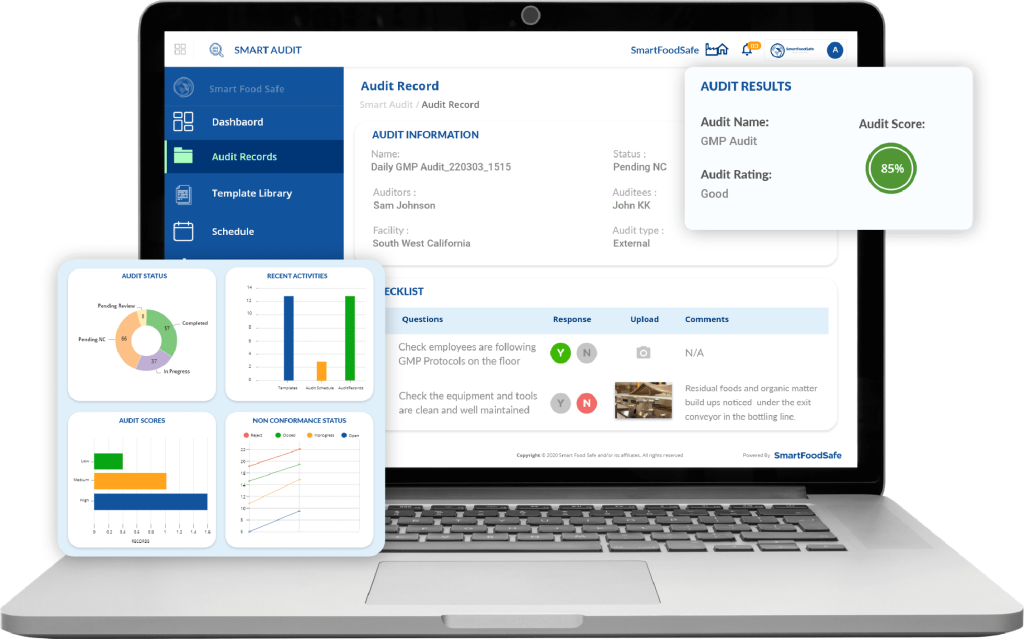
Traceability is one of the most critical elements of FSMA, HACCP, and GFSI compliance. Audit software enhances traceability through
All records from inspections to CAPAs are stored securely and can be retrieved instantly during audits.
Ensures all employees use the latest:
This prevents outdated processes from creating compliance gaps.
Â
Every change, update, audit entry, or corrective action is automatically time-stamped and logged, providing an unbreakable audit trail.
Â
Instead of paper-based logs, all data is captured digitally, improving accuracy and eliminating missing entries.
Â
Audit software ensures:
These ensure compliance with regulatory expectations for secure recordkeeping.
Corrective and preventive actions (CAPA) are at the heart of every food safety standard. Audit software transforms CAPA management through:
When an issue is detected:
Structured digital forms guide teams through:
The system sends reminders until the CAPA is completed, ensuring no task goes overdue.
Â
Supervisors can easily verify corrective actions with:
Â
Smart dashboards show:
This is essential for HACCP verification and GFSI certification audits.
Audit reporting is usually one of the most time-consuming parts of compliance. Digital audit management eliminates the manual effort.
Generate:
with one click.
Â
Export reports in:
Â
Heatmaps, charts, and risk matrices help teams understand compliance performance at a glance.
Â
Set up automated weekly or monthly compliance reports for management, reducing administrative burden.
Â
During third-party or regulatory inspections, reports can be retrieved instantly—no more searching through binders.
Modern digital audit systems go far beyond simple checklists. They combine pre-built compliance frameworks, operational audit tools, and customizable templates to support consistent, risk-based auditing across facilities, processes, and standards.
Below is a breakdown of the core tools and templates typically provided by digital audit software.
Most digital audit platforms come equipped with industry-aligned templates designed to simplify regulatory compliance and certification readiness. These templates help organizations standardize audits while reducing manual setup time.
Common pre-built templates include:
These templates ensure audits are aligned with recognized standards while maintaining consistency across locations.
Beyond templates, digital audit systems provide functional tools that support end-to-end audit execution, follow-up, and analysis.
Key digital tools include:
Together, these tools reduce administrative effort while improving audit accuracy and follow-through.
In addition to standard frameworks, digital audit systems allow users to create custom audit templates tailored to their unique operational requirements.
Custom templates can be aligned with:
This flexibility enables organizations to apply a single digital audit platform across multiple facilities, products, and regulatory frameworks without compromising audit quality or compliance.
As FSMA, HACCP, and GFSI standards become more rigorous, relying on manual systems is no longer sustainable. Audit Management Software transforms compliance workflows, reducing errors, improving traceability, and ensuring organizations maintain audit readiness at all times.
From automated monitoring to instant reporting, structured CAPA workflows, and centralized documentation, digital audit systems have become the backbone of modern food safety operations.
Businesses that embrace digital audits gain:
Migrating to digital audits isn’t just an upgrade, it’s a strategic necessity for future-proof food safety compliance.
Yes. Digital audits eliminate paperwork, improve accuracy, and offer better traceability.
Absolutely. Regulators encourage digital documentation due to superior accuracy and traceability.
Yes. Administrators can control templates, monitor compliance, and standardize operations across all sites.
Most advanced platforms do. Data syncs automatically when back online.
Yes. With centralized data, reports and evidence are always ready for inspections.
Minimal. Most modern solutions are user-friendly and require only short onboarding.
Have a consistent, working internal audit strategy that continuously brings about compliance in the middle of regulatory updates with Smart Audit’s audit management features.
Signup to receive latest news, insights and updates on audits management