22 Nov 2025

Operational audits have emerged as an essential management tool, helping organizations go beyond financial accuracy to drive strategic improvements in performance, efficiency, compliance, and risk mitigation. Here we are answering some of the key questions users commonly ask about operational audits, offering clarity for executives, managers, auditors, and stakeholders seeking to better understand this powerful evaluation process.
An operational audit is a systematic and comprehensive review of an organization’s internal processes, systems, and operations. Its primary aim is to evaluate the efficiency, effectiveness, and economy of operations under the control of management. Unlike financial audits that focus on accounting records, operational audits are forward-looking and delve into how business activities can be improved to support long-term goals.
According to the Institute of Internal Auditors, operational audits are focused on evaluating how well an organization’s operations align with its objectives, and they culminate in actionable recommendations to drive improvement.
The primary purpose of an operational audit is to help organizations enhance their overall performance by identifying inefficiencies, uncovering risks, and recommending process improvements. Specifically, operational audits aim to:
Streamline operations and improve productivity
Optimize the use of resources
Identify and mitigate risks
Ensure compliance with policies, laws, and regulations
Support data-driven decision-making
Promote a culture of continuous improvement
Protect company assets and reputation
To conduct a comprehensive operational audit, several core components must be evaluated:
Operational audits can be customized to specific organizational needs. Some common types include:
Operational audits deliver wide-ranging benefits across various levels of an organization. By offering deeper insights into how processes function and where they can be improved, these audits contribute significantly to organizational growth and sustainability.
They also highlight inefficiencies in processes, helping organizations cut unnecessary costs and improve resource utilization.
The findings support long-term strategic planning by providing accurate, actionable information that leaders can use to guide decisions.
They also help foster a workplace culture centered on accountability, continuous learning, and performance.
This can lead to stronger collaboration and engagement among teams
They push companies to not just focus on profits, but to operate in a way that benefits the broader community and the environment.
A typical operational audit follows a structured process:
Start by clearly outlining what the audit will cover. Focus on specific areas of the organization based on strategic priorities, operational risks, or findings from previous audits.
Gather all necessary documentation, including policies, reports, performance metrics, and process records. Conduct both qualitative and quantitative analyses to identify patterns, inefficiencies, or areas of concern.
Interview relevant personnel such as managers, supervisors, and frontline employees. These discussions help validate data, reveal ground-level challenges, and offer context to operational findings.
Assess all findings to pinpoint specific shortcomings—be it process delays, control breakdowns, resource misuse, or underperformance—that hinder operational efficiency and effectiveness.
Translate audit findings into clear, practical recommendations. Ensure each suggestion is SMART—Specific, Measurable, Achievable, Relevant, and Time-bound—with assigned accountability.
Work closely with relevant teams to execute the recommended changes. Establish metrics and monitoring mechanisms to evaluate the effectiveness of implementation over time.
Schedule follow-up audits or progress checks to verify that improvements have been maintained, issues have been resolved, and new risks are addressed proactively.
While operational audits offer numerous benefits, businesses may encounter some challenges:
Operational audits heavily rely on accurate and comprehensive data for analysis. However, many organizations struggle with poor data quality due to outdated systems, manual entries, or fragmented information sources. Inaccurate or incomplete data can distort audit findings, making it difficult to draw meaningful conclusions or identify root causes of inefficiencies.
Audit recommendations often call for changes in existing workflows, behaviors, or control structures. This can lead to resistance from employees or even management, especially if they perceive the audit as a threat or disruption. Resistance may stem from a lack of understanding of the audit’s purpose, fear of additional workload, or discomfort with transparency.
Operational audits can be resource-intensive, requiring dedicated time, personnel, and access to multiple departments. For smaller organizations or understaffed teams, allocating the required resources may be difficult. In such cases, audits may be rushed, under-scoped, or delayed, compromising their effectiveness.
Even when an audit successfully identifies actionable recommendations, businesses often face challenges in translating these into action. Follow-through may be hindered by lack of accountability, competing business priorities, or unclear ownership of corrective tasks. This can result in recurring issues and minimal long-term improvement.
Larger organizations or those with decentralized structures, multiple locations, or varied business units can present a complex auditing environment. Diverse workflows, inconsistent documentation, and differing operational standards across units make it difficult to create a unified audit framework, potentially diluting the quality and applicability of the findings.
Companies can significantly organize the operational audit process by harnessing modern technology, which not only enhances the efficiency of audits but also improves their overall quality and outcomes. The integration of technological solutions offers a range of benefits, from better data management and real-time insights to improved collaboration and risk management. Here’s a comprehensive look at how companies can achieve these best outcomes:
Embrace Integrated Audit Management Platforms – A critical step towards streamlining audits is implementing centralized audit management systems. These platforms provide a single source of truth where all audit-related documents, procedures, and findings are stored in one place. This centralization helps eliminate redundant work, minimizes errors, and ensures that historical data is easily accessible for trend analysis and comparison.
Leverage Automation for Routine Tasks – Automation technologies can drastically reduce the time spent on data collection, documentation, and analysis. Routine tasks—such as data extraction, report generation, and scheduling—can be managed by automated systems. This not only frees up auditors to concentrate on more critical, analytical work but also reduces the likelihood of human error.
Utilize Cloud-Based Solutions and Real-Time Data – Moving to cloud-based audit systems enables companies to leverage real-time data and remote collaboration. Cloud solutions offer scalability, security, and accessibility, allowing audit teams to access updated information anytime, anywhere.
Continuous Monitoring and Improvement – Technology-driven audits are not a one-off activity—they facilitate continuous monitoring. With automated tools and real-time data feeds, companies can transition from periodic audits to ongoing assurance processes. This continuous monitoring approach not only ensures immediate detection of issues but also allows organizations to continuously refine and improve their operational processes.
Adaptive Frameworks: Use insights gained from continuous audits to update and improve policies and procedures proactively.
Smart Audit is a front-runner in the market to optimize the entire operational audit lifecycle by automating audit planning and scheduling through configurable workflows that trigger timely notifications and task assignments based on frequency, risk level, or location. It enables mobile, paperless field auditing with offline capabilities, allowing auditors to capture data, photos, and comments in real time without relying on manual documentation.
Standardized, customizable templates with built-in scoring and validation rules ensure consistency and accuracy across audit types. All audit data and supporting evidence are stored in a centralized, cloud-based system, improving accessibility, traceability, and record management. The platform streamlines non-conformance handling by initiating CAPA workflows, assigning root cause investigations, and tracking issue resolution with automated alerts and escalations. Its robust analytics capabilities turn audit data into actionable insights, helping organizations identify recurring issues, monitor trends, and drive continuous improvement. Designed for scalability, Smart Audit allows templates and workflows to be duplicated and adapted across sites and departments, making audits repeatable, efficient, and aligned with organisational objectives.
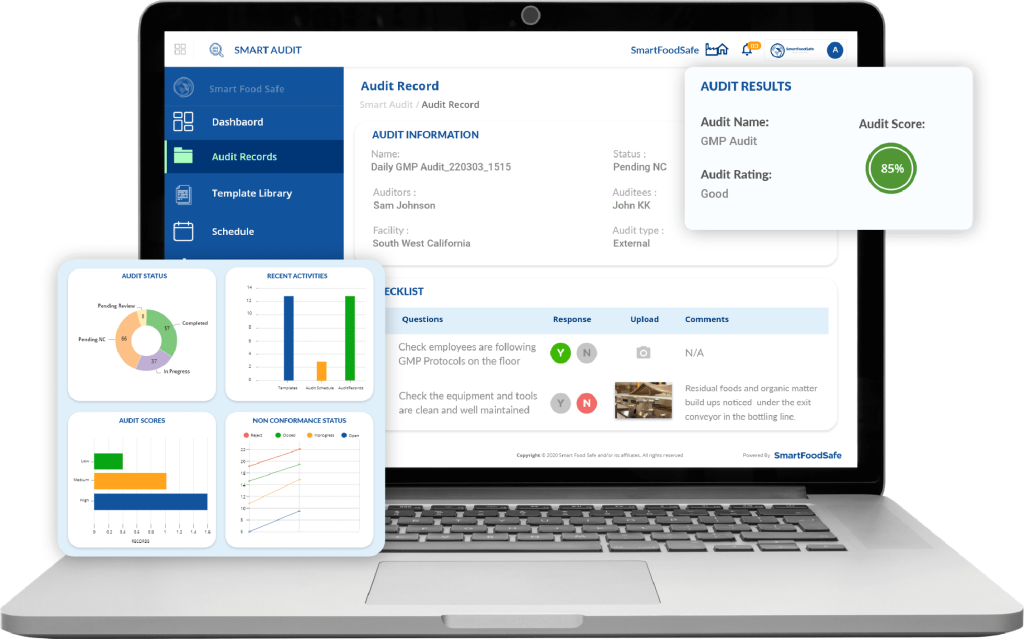
Have a consistent, working internal audit strategy that continuously brings about compliance in the middle of regulatory updates with Smart Audit’s audit management features.
Have a consistent, working internal audit strategy that continuously brings about compliance in the middle of regulatory updates with Smart Audit’s audit management features.
Signup to receive latest news, insights and updates on audits management

 English
 French
 Spanish

