English
 French
 Spanish


How equipped are you to deal with an announced EHO inspection? Are you confident your food business will pass with flying colors? If not, it’s time to take control of your compliance strategy.
Every food business, from restaurants to cafés, pubs, and catering services, must adhere to food safety laws. EHO inspections determine your compliance level and assign a hygiene rating that impacts customer trust, your business reputation, and, ultimately, your success. Being unprepared isn’t an option—continuous compliance is the key.
Comprehending EHO Inspections
An EHO (Environmental Health Officer) is a government-appointed expert responsible for inspecting food businesses and enforcing food safety laws. Their primary role is to prevent health hazards by ensuring businesses comply with hygiene regulations. Inspections focus on food handling practices, the condition of premises, and food safety management systems. Regardless of your business size, you are subject to these inspections, making preparation a non-negotiable aspect of food service operations.
However, EHO inspections are often misunderstood. They’re not just about ticking boxes or catching businesses out. Instead, they’re an opportunity to demonstrate your dedication to maintaining the highest standards. Think of them as a health check for your business—a chance to identify areas for improvement and reinforce your reputation as a safe and trustworthy establishment.
How Often Can EHO Inspections Happen
The short answer? Anytime. EHOs don’t need appointments.
Inspection frequency depends on your risk rating under the Food Law Code of Practice:
A (High Risk): At least every 6 months
B: At least every 12 months
C: At least every 18 months
D: At least every 2 years
E (Low Risk): At least every 3 years
Given this unpredictability, you must maintain compliance at all times. Having a structured approach—such as using a comprehensive environmental health inspection checklist—ensures you’re always ready.
Realistic Expectations When Facing an EHO Inspection
If you run a food business, an Environmental Health Officer (EHO) visit is inevitable. EHOs don’t just check your kitchen cleanliness—they assess compliance by thoroughly examining food businesses, everything from food storage practices to paperwork compliance. They take photographs, collect samples, review records, observe food handling, and interview staff to assess knowledge. Understanding exactly what they look for can help you stay prepared and avoid penalties.
Food Storage & Temperature Control
EHOs will check whether perishable foods are stored at the correct conditions.
⇒ Refrigeration and freezer units – Are they operating at the correct temperatures (below 5°C for chilled food, -18°C or lower for frozen food)?
⇒ Temperature logs – Do you have a system in place to monitor and record food temperatures consistently?
⇒ Stock rotation – Are expired or improperly stored ingredients present? They may open containers and check expiration dates.
Cross-Contamination Prevention
Preventing cross-contamination is a major focus during inspections.
⇒ Raw vs. cooked food storage – Are raw meats stored separately from ready-to-eat foods?
⇒ Color-coded chopping boards and utensils – Are different boards used for raw meat, seafood, vegetables, and cooked foods?
⇒ Food handler hygiene – Are employees washing hands properly and following glove-use protocols?
Cleaning & Sanitization
EHOs will evaluate how well your cleaning procedures prevent bacterial buildup. This includes:
⇒ Cleaning schedules – Is there a documented cleaning plan for surfaces, equipment, and high-risk areas like sinks and drains?
⇒ Sanitization chemicals – Are the correct cleaning agents used, and are they stored safely?
⇒ Deep cleaning records – How often are hard-to-reach areas, like fridge seals and extractor fans, cleaned?
Pest Control Measures
Nothing will trigger a compliance issue faster than signs of pest activity.
⇒ Pest control records – Do you have an up-to-date contract with a pest control service?
⇒ Physical evidence – Are there droppings, nesting materials, or insect activity in storage areas?
⇒ Sealing of entry points – Are doors, vents, and drains protected against rodents and insects?
Food Safety Documentation
Paperwork is just as important as physical inspections.
⇒ Food safety management system (HACCP-based plans) – Do you have a documented process for monitoring food safety risks?
⇒ Keep documentation updated – Ensure that temperature logs, cleaning schedules, and pest control records are maintained and accessible.
⇒ Training certificates – Have all food handlers completed food hygiene training?
⇒ Allergen control processes – Are allergen risks identified and communicated correctly?
Internal Audit Routines & Staff Training
Conduct thorough internal audits to prep the operations and employees for being EHO inspection-ready.
⇒ Conduct self-audits – Regularly review storage, hygiene, and record-keeping to spot compliance gaps before an official inspection.
⇒ Train your staff – Make sure employees understand food safety procedures, from handwashing to correct food labeling.
Meeting EHO Expectations: Key Steps to Stay Ahead
Avoid the stress of last-minute scrambles by implementing a well-established system to be prepared prior to EHO inspections. Here’s how you can ensure your business is always compliant:
Step 1: Understand the EHO Inspection Criteria
EHOs evaluate food handling, cleanliness, and safety management systems. Knowing what they assess helps you prepare strategically and avoid compliance pitfalls.
Step 2: Implement a Robust Food Safety Management System
A structured food safety system ensures compliance with regulatory standards. Maintain clear documentation of processes, enforce strict hygiene policies, and conduct regular training sessions.
Step 3: Keep Your Premises in Top Condition
Ensure all areas of your food business are clean, well-maintained, and pest-free. Address structural issues, implement thorough cleaning schedules, and manage waste efficiently.
Step 4: Train Your Staff to Handle Inspections
Your team should be well-versed in hygiene standards, food handling procedures, and emergency response protocols. Regular training ensures they’re inspection-ready at all times.
Step 5: Conduct Regular Self-Audits
Use an internal checklist to conduct routine inspections. This strategy helps you identify weaknesses before an official EHO visit.
Step 6: Monitor Performance & Make Continuous Improvements
Track temperature logs, hygiene records, and employee compliance with safety policies. Address minor issues before they escalate.
Step 7: Maintain a Consolidated System for Documentation
Keep records of audits, training sessions, cleaning schedules, and corrective actions. Having well-organized documentation demonstrates your commitment to food safety.
Step 8: Being Compliant Post-Inspection
Passing an EHO inspection is just the beginning. To maintain compliance long-term, food businesses should:
- Address any corrective actions promptly to prevent repeat violations.
- Regularly update food safety practices, stay informed on industry trends, and adapt to regulatory changes.
- Utilize technology to automate record-keeping, streamline audits, and ensure compliance remains a priority.
Aftermath of Failing an EHO Inspection
Failing an EHO inspection can have serious consequences, but it’s not the end of the road. If significant issues are found, the EHO may issue a Hygiene Improvement Notice, Emergency Prohibition Procedure, or Seizure and Detention Notice. These notices require immediate action to address the identified hazards.
A. Hygiene Improvement Notice
Issued when food hygiene rules are breached, requiring corrective actions within a set timeframe (usually 14 days). Failure to comply can lead to fines or closure.
B. Emergency Prohibition Procedure
If operations pose immediate health risks, EHOs can issue a prohibition notice, forcing certain processes to stop until compliance is restored.
C. Seizure and Detention Notice
If food products fail to meet safety standards, they can be detained or seized to prevent public health risks.
However, with a proactive approach and a commitment to ongoing improvement, you can turn a failed inspection into a learning opportunity. Address the issues promptly, document your corrective actions, and use the experience to strengthen your food safety practices.
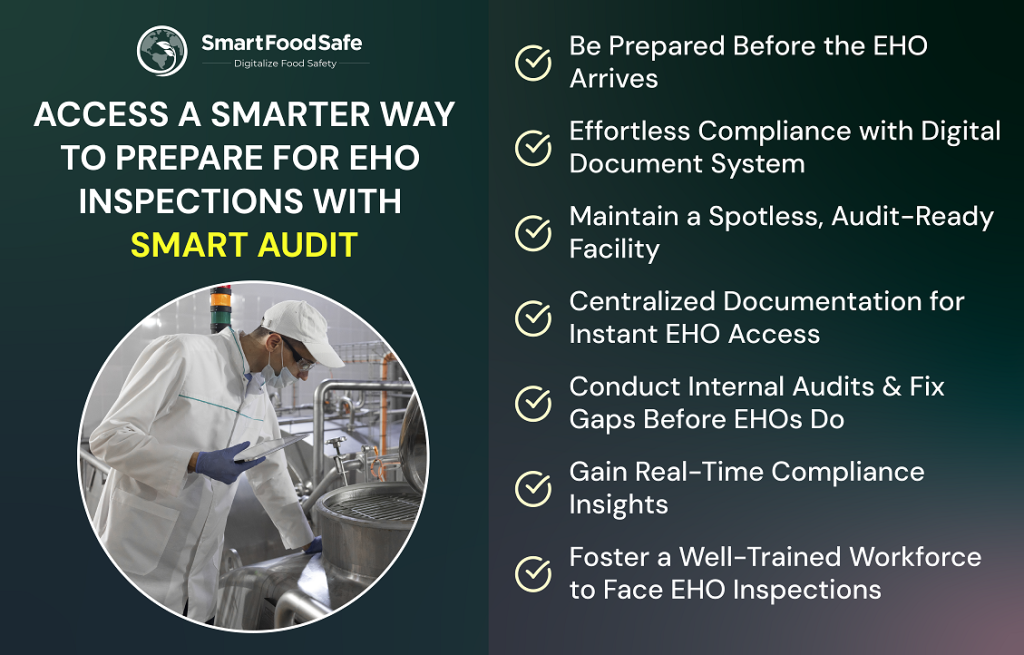
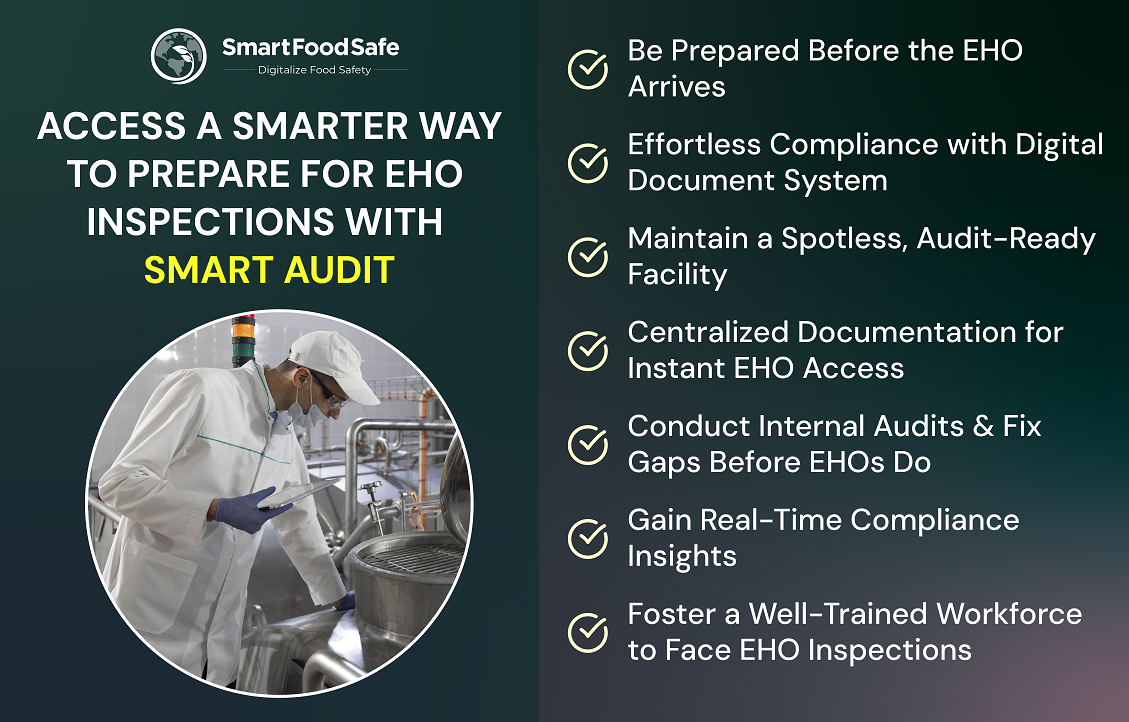
Access a Smarter Way to Prepare for EHO Inspections With Smart Audit
Preparing for EHO inspections doesn’t have to be a headache. With Smart Audit, you can automate time-consuming tasks, minimize human errors, and maintain top-tier hygiene standards, to breeze through audits with ease, without the last-minute scramble.
Be Prepared Before the EHO Arrives
EHOs assess food businesses based on strict hygiene and safety regulations. Automated audit workflows in Smart Audit keep your records up to date, align your processes with compliance standards, and ensure key documents are instantly accessible. No more scrambling for paperwork when an inspector walks in!
Effortless Compliance with Digital Records
From hygiene policies and staff training logs to corrective actions, digital record management in Smart Audit centralizes all compliance documentation in a cloud-based system. This ensures that when EHOs request records, you can retrieve them instantly—demonstrating due diligence without delays.
Maintain a Spotless, Audit-Ready Facility
EHOs focus on hygiene, pest control, and maintenance. Task scheduling in Smart Audit helps you plan and track cleaning routines, equipment maintenance, and pest control efforts, ensuring your facility remains in top condition every day.
Empower Your Team with Training & Readiness
EHOs often question staff on food safety protocols. Integrating with the training management module Smart Training, Smart Audit equips you to track certifications, schedule refresher courses, and ensure your team is well-versed in hygiene and handling procedures—so they can confidently demonstrate compliance.
Conduct Internal Audits & Fix Gaps Before EHOs Do
Proactive internal audits are key to avoiding compliance failures. Customizable audit checklists in Smart Audit align with EHO expectations, helping you identify and resolve potential issues before inspections—ensuring you’re always ahead.
Gain Real-Time Compliance Insights
With real-time audit tracking, Smart Audit provides instant visibility into compliance records and trends. Detect minor issues before they escalate, take corrective action immediately, and maintain an always-ready audit status.
Centralized Documentation for Instant EHO Access
When EHOs request documentation, delays can raise red flags. Cloud-based document storage in Smart Audit keeps all reports, training logs, and corrective action records in one secure location—so you can retrieve and present evidence of compliance in seconds.